

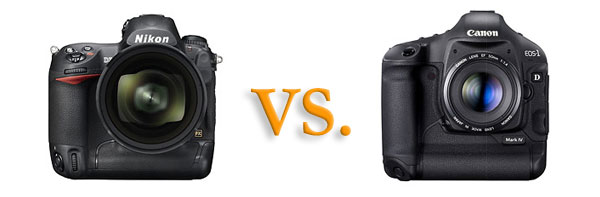
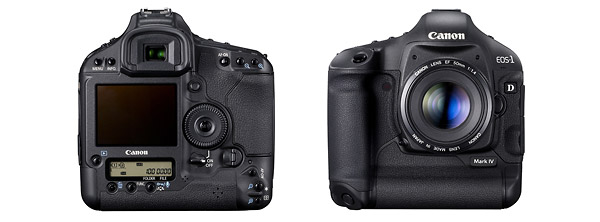
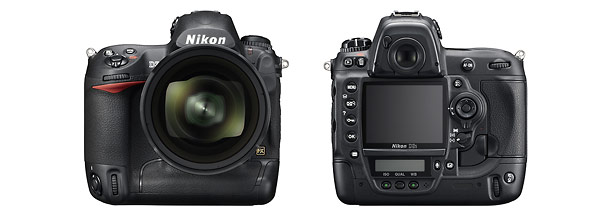
These two powerhouse pro digital SLRs were announced within a week of each other. They both cost about $5000, both have HD video, fast capture rates and a ridiculously high ISO 102,400 sensitivity. It’s impossible not to wonder which one is the better camera. So I thought it would worth the effort to, as closely as possible, do a back-to-back comparison of the Nikon D3S and. the Canon EOS-1D Mark IV.
It may be a little premature for this comparison since Canon hasn’t published and sample images yet. (Note: we now have high-res studio samples for both cameras – see all digital camera studio sample photos.) But that’s ok. As more real-world testing and high-res sample photos become available we can add information in the comments section below. I did a similar article when the Nikon D90 and the Canon EOS 50D were announced (Nikon D90 vs. Canon EOS 50D vs…). At the time they seemed pretty comparable. But it quickly became clear that the Nikon D90′s super low noise made it the better camera. But for now we’ll work with what we have and compare the new 1D Mark IV and Nikon D3S by specs alone.
Editor’s Note: Since this article was published (October 22nd, 2009), we’ve received both the Nikon D3S and the Canon EOS-1D Mark IV for review. I’ve added links for sample photos and an auto focus comparison on another site to this article. There’s also an updated conclusion at the end. So if you’ve already read this you might want to skip to the end. If you want to see what I’ve shot with both cameras, you can see my Canon EOS-1D Mark IV photos here, and my Nikon D3S photos here.
Canon EOS-1D Mark IV Announcement
Canon EOS-1D Mark IV Sample Photos
Nikon D3S Announcement
Nikon D3S Sample Photos
Compare Nikon D3S and Canon EOS-1D Mark IV Camera Specs
| Nikon D3S | Canon EOS-1D Mark IV | |
| Sensor type | Full frame CMOS | APS-H CMOS (1.3x crop factor) |
| Resolution | 12.1 megapixels (4256 x 2832) | 16.1 megapixels (4896 x 3264) |
| Pixel size | 8.45 microns | 5.7 microns |
| Sensitivity | ISO 200 to 12,800 – expandable to ISO 102,400 | ISO 100 to 12,800 – expandable to ISO 50 and 102,400 |
| Burst rate | 9 FPS (max resolution, RAW) | 10 FPS (max resolution, RAW) |
| Auto focus system | 51 points with 15 cross-type sensors | 45 points with 39 cross-type sensors |
| Flash sync | 1/250th second | 1/300th second |
| Exposure bracketing | 9 frames in 1/3, 1/2, 2/3 or 1 stop steps | 7 frames in 1/3 or 1/2, stop steps |
| Battery capacity | Approximately 4200 photos | Approximately 1500 photos |
Compare Nikon D3S and Canon EOS-1D Mark IV Video Specs
| Nikon D3S | Canon EOS-1D Mark IV | |
| Video resolution | 720p (1280 x 720) | 1080p (1920 x 1080) |
| Video frame rate | 24 FPS | 30, 24, 25 FPS at 1080p / 60 FPS at 720p |
| Video focus control | Single-shot contrast-detect auto focus with live touch-up AF | Single-shot contrast-detect auto focus (pre-focus) or manual focus |
| Video exposure control | Auto and aperture priority | Auto and full manual |
| Stereo sound | With optional external stereo mic | With optional external stereo mic |
| Video file format | .AVI | .MOV |
Nikon D3S vs. Canon EOS-1D Mark IV Image Quality
Let’s dig into these specs a little and see what more we can learn from them – feel free to add your own observations in the comments section at the bottom of the page! The Nikon has a 12-megapixel sensor and the Canon has a 16-megapixel sensor. Looks like the Canon is better, right? Not so fast, partner. The Nikon’s larger, full frame sensor and lower resolution means it has bigger pixels – much bigger (8.45 microns compared to the Canon’s 5.7 micron pixels). Bigger pixels mean less noise and one of the main specs both camera makers are pushing is high ISO sensitivity. Nikon has published sample images at ISO 6400 and they look wonderful. Canon has yet to publish any 1D Mark IV sample images but with about 30% less surface area on each 1D pixel, they’ll be hard pressed to match the low noise of the D3S.

next page – Nikon D3S & Canon EOS-1D Mark IV Video, Auto Focus and Conclusion >>
Canon EOS-1D Mark IV Reviews & Shopping
Nikon D3S Reviews & Shopping


Hi, Regarding the Pixel size difference and from that, the image quality, I wonder what would happen if I enlarge the same picture, taken at the same conditions with both cameras at the same time.
Would resolution prime, or would be the sensor’s pixel size?
Thanks.
I’m not sure what you mean by “prime.” Canon has done a lot to address noise with the new 1D Mark IV. But I’m sure Nikon has, too. Until we see sample images from the Canon all we can do is speculate based on the camera specs. And pixel size is the most telling because larger pixels collect cleaner information. On the other hand, the Canon has 30% more resolution than the Nikon. So it’s possible that the increased resolution will effectively minimize any increased noise in prints of the same size. When we get the cameras for testing and review we’ll make studio tests and publish them at full size. Then you can make test prints and see for yourself. Here’s a link to our digital camera studio tests, where you’ll find the high-res samples when they’re available: http://www.photographyreview.com/samplephotoscrx.aspx
I hope that answers your question. If it doesn’t let me know and I’ll try again. Thanks for commenting
I’m not sure if things have changed for the 1D mark IV, but the 1D mark III does 3 AEB at +/-3.0 steps with a custom function that expands it to 2, 3, 5, or 7 frames. I know that custom function allows at least up to a full 1.0 step between each (but I’m not sure if it expands to more than 1.0 for steps using that custom function). I know this is really super picky, but saw you had the 1D mark IV at up to 7 and only 1/3rd or 1/2 steps. Does canon have this info posted yet? I’m surprised to see that they would have cut back on the 1D mark III’s range.
I’m more than curious. I pre-ordered the mark IV the night of the launch.
The bracketing specs were taken right off Canon’s 1D Mark IV page. I double and triple checked to see if it allowed a full stop for bracketing but I only saw 1/3 and 1/2 steps. It is possible I was wrong. If you want to take a look for me and see if I made a mistake, I would welcome the second look
http://cweb.canon.jp/camera/eosd/1dmk4/samples/index.html Canon sample images from the Mark IV
Awesome – thanks, Kevin! I’m looking forward to taking a closer look at the samples when I’m not using my phone to browse the Web
I’m not sure that 100,000 ISO is ridiculous. When I do photos in the street at night (example: Nuit Blanche) at 3200ISO with a f1.8 lens I’m working with a a slow shutter speed. The camera is not able to record the scene as I see it with my eyes. Higher ISO will be useful in extreme conditions.
Having said that – I can wait. These cameras are too big for me (I’ve already handled a D3s).
Regarding the battery life, I’m wondering why the 1d4 will be so much less than the 1d3? Right now I’m getting close to 4000 shots on my 1d3.
Regarding the autofocus, I wouldn’t call the 1d3 the autofocus winner over the d3, my 1d3 still can’t focus without something high contrast for it to pick up on in low light situations. As far as celebrity photojournalism goes, I’d say that about 75% of the canon shooters have ditched canon for their faults. That’s a huge number!
While Nikon’s autofocus might not be as fast as canon’s, they’re consistency and lower “failure to focus rate” puts them in the lead (atleast in my line of work).
On the last note, Image quality. The primary lenses that I shoot with are the Canon 24-70 f/2.8 and Canon 70-200 f/2.8 IS, compaired to their nikon counterparts they are lacking(there is a rumor of a canon 70-200 mark2). Basically what I’m getting at is, comparing shots with a nikon d3 to my canon 5d mk2, I’m more impressed with the Nikon than the 5d2. Colors and contrast are amazing, and the 5d2 has seemingly more noise at lower ISO than the nikon(possibly to the ridiculous pixel count/size).
I’ve been a canon shooter since I began shooting, but they’re letting me down! I’m not very impressed with the 1d4, especially since a few beta testers shot with a full frame version of the 1d4.
Cheers
I definitely agree with Mark. Nikon is hands down better in every way except for maybe the video, which shouldn’t be an issue if you’re a photographer. The video is just an added bonus…nothing most photographers would care much about.
By pure physics, the nikon’s high ISO performance will be significantly better due to less mp in nikon and a full frame sensor. The battery life is better, the build quality of the D3 is proven to better than the 1D. The controls are more intuitive in my opinion on the Nikons. The zoom lenses on canon are no match for nikon’s pro zooms. I’ve tested the 5d mk ii and the 1d mk iii with the D700 and D3. In all cases nikon produced cleaner and better results.
The AF system? Don’t get me started, Canon is TERRIBLE compared to Nikon.
Seems like Canon is more concerned with making their cameras appear good on paper and taking the lead in megapixels and high tech features, whereas nikon provides what photographers really need…High iso performance, battery life, build quality, and the ability to get in focus pictures!
I am thoroughly convinced that if someone shoots canon they haven’t tried nikon’s pro bodies, because once they get the feel of them they will no doubt agree nikon is better…specially for wedding photographers.
Malik and Mark – thanks for posting. Nikon auto focus is one of my blind spots. I’ve used plenty of Nikon DSLR bodies but I’ve yet to do any serious sports shooting with them. By serious I mean, high-speed, continuous AF event action shooting. I find that’s where it really counts. And I intend to address this problem when I can get my hands on a D3S.
Nikon D3s pixel area is 2.2 times larger (i.e. 120 % larger, or more than double) than the Canon Mk IV. Not “about 30 % less surface area” as stated in the article text. 30 % accounts only for one dimension, area is two dimensional. That should make a difference both in noise and dynamic range.
However, to be fair one should compare pictures of the same final reproduction size. Canon MkIV need to enlarge the picture 1.3 times more (linear) than the Nikon D3s to reach the same reproduction size, meaning that also lens imperfections are magnified 1.3 more with the Canon camera (independent from the number of pixels).
Thanks for the correction, Ryler. And you’re right about the Canon’s extra resolution potentially compensating for its smaller pixels. Besides the resolution, Canon has also improved their noise reduction with the new camera. Still, I think it’s unlikely that the new 1D will match the image quality of the D3S – at 100% or in print. Right now I can only speculate based on the published information. Ultimately I need to get both of these cameras in the studio for controlled tests. I’m really lookiing forward to doing that – and to doing some serious sports shooting with the D3S.
No problem photo-john, will be looking forward to your tests to further show why this is not even a competition. I hope you get the chance to test and compare
1) high iso images
2) AF performance (including during fast action sports)
3) Build quality and Feel of camera
I also think during these tests similar lenses should be used, for example 70-200 2.8 from both nikon and canon on the D3s and 1D mk iv respectively.
Malik-
I’m not sure if we’ll get to compare them back-to-back as you’re suggesting, although that would be very useful. The high ISO tests are a given. You can see all of our controlled studio tests here: http://www.photographyreview.com/samplephotoscrx.aspx
As soon as I can get the D3S and 1D Mk IV I’ll make those tests and post them.
Sports is my main subject and I really want to do some serious shooting with the D3S and the Nikon AF-S 70-200 VR II lens. Like I said in a previous comment, I know that Nikon AF performance is one of my photographic blind spots and I intend to address that with the D3S. I have plenty of experience shooting with the Canon bodies and 70-200 f/2.8L so there’s no mystery there. It’s just a matter of seeing how much Canon has improved on the previous system and if there are any performance issues.
“dmm”
Yes I wrote up my comments about the D3s vs 1d mk iv and pasted my comments about them two other places as well. I gain nothing out of it, as I already am shooting nikon. I’m a wedding photographer. My only goal is to inform others of why Nikon is the BETTER system if you’re a wedding photographer because of their high iso performance. I often shoot in churches where a flash isn’t allowed, in those cases the only thing that matters is the ability to acquire focus in low light and the ability to get clean shots at high ISOs. I have extensively tried the canon’s 1D mk iii and the 5d mk ii in those situations, except they got no where as close to the image quality as my d700 and D3 can provide. When using the canon bodies in those situations, I felt so glad that I had nikon’s but also felt bad for my friend whom I borrowed the canon equipment from. He can’t get the same image quality in the same situations as me only because he has canon bodies. So I felt that is’ necessary to emphasize how much of a difference there is in the high iso performance of these two bodies.
So to summarize…I gain nothing, but I’m trying to inform other photographers who shoot in low light that when picking a system…if low light Af performance and high iso noise performance is your main concern for stills, Nikon is the way to go. And I do believe they will be glad I suggested that to them. I have nothing against canon, everything i said is objective. I have no allegiance to nikon. I’m just objectively stating what’s best in a given situation.
Malik!
I was on 4 weddings this year, and none of the photographers shoots with nikon!
You did not try any canons, and stop running from one forum to another writing same bs!
If you feel that you made wrong decision buying nikon, than sell it on ebay!
I’m user of canon, and all my friends left nikon for canon some time allredy, and you just guess what? They all happy they did!
Instead of whining, use you tools and enjoy them, and try other setting than magic green square!
Malik-
Thanks for replying to DMM. Unfortunately, I had to remove his post because of the profanity. Based on the specs and what I’ve been seeing from Canon, I agree that the D3s will likely have better image quality than the new 1D Mark IV. Not sure about the build quality or AF comments, though. The build quality of both cameras is excellent and my experience with the 1D Mk III AF was great, in spite of the known issues. I think the auto focus updates that Canon has made with the new camera look really, really good. But of course, we won’t know how good until we can actually try it. Right now pretty much everything is speculation. The intent of this article was to put some context around that speculation.
Good pre-comparison, but you did make one mistake. When you state “The one area where the Nikon D3S has an edge is auto focus. Unlike every other video-enabled digital SLR, the D3S auto focus system does work during video capture. It doesn’t have full continuous auto focus like a proper dedicated video camera. But you can touch up the auto focus while you’re filming. With every other digital SLR you have to either stop filming and refocus or adjust the focus manually,” this is not entirely true. I own a 7D and have used the AF-On Button DURING video recording to adjust the focus. Therefore, the D3S is not the only camera to offer this.
Furthermore, you state that you are not sure if this is good or not but a step in the right direction. I would like to add a little insight: I have a 5D Mark II also, and the focus is strictly manual on that camera. It can be a tad frustrating to try and work a manual focus on an SLR while viewing a LiveVIew screen. I’ve had a tendency to twist the focus the wrong direction sometimes and then re-compensate & it doesn’t look good at all. Tapping it in with AF is far less noticeable. So it definitely offers an advantage if you’re trying to capture something quick, on the fly, and without an option to re-shoot.
Regarding the size of the pixels on the Nikon versus the Canon: I think the point made about the larger pixels having a lower noise is great, but the real question will come down to the noise level when comparing an image of identical size. If a 16MP image has slightly more noise but is shrunk to the same number of pixels, to the same size in other words, as the Nikon image, what will the noise comparison be, all other things equal. The one thing we do know for sure is that you can’t upsize 12MP to 16MP.
Another item is the speed. Your chart states the speeds at 9fps for the Nikon and 10fps for the Canon. There was some vaporous detail in the Nikon spec sheet about 9-11fps and it would be interesting to understand where they are getting the extra speed. I’ve heard on past Nikons it is via a grip, however, this camera appears to already be built size for the grip portion.
And finally, an item that was not addressed was the cropping itself. These are both Sports cameras and that is the market they are directed towards. I have read in previous reviews on various occasions that Canon has a 1.3x crop sensor because Sports pros prefer a slight crop. The Nikon spec stated they had a 1.2x crop available on the D3S, which lends truth to this concept. I didn’t see this stated outright, but I would assume that if you shoot at 1.2x crop on the Nikon you’re simply cropping the shot and will lose a little more resolution – down to perhaps a 10MP shot. I think addressing this portion of the comparison is significant also.
I have a photographer friend who uses Nikons and obviously I’m a Canon user. These types of articles are very useful and fuel for discussion. Since we both pay very close attention to both manufacturers and this little digital war they’ve had going for some time now.
Great posts everyone. I’m really looking forward to the results from both these cameras. I am a wedding photographer, and I currently use nikon bodies. However, I can easily switch systems since I rent most of my lenses as events come. This gives me the advantage of having the best body out for my needs, and what I need is good high iso performance, IQ, and autofocus accuracy. Megapixels is the least of my concern and I try to get the composition right when taking the shot, and this eliminates the need for cropping.
I’m just wondering when people will have access to the 1d mk iv and the D3s to do real world comparisons, because I know that numbers on paper are one thing and real life results can be different. Although the new AF from canon on paper does seem very good, 39 cross type points vs 15 of nikon…but testing will determine how good it really is and if it can be as good or better than the tried and trusted nikon’s 51 pt AF system. One thing I know almost is a fact is the high iso performance on D3S will be better.
And Zen, I have shot weddings with the 5d mk ii many times so I did try canons… And I have many friends who left canon for nikon as well. And fyi the nikons pro bodies don’t have a “green” square mode like the canon’s 5d mk ii, the most full auto mode the nikon’s pro bodies have is P mode.
I was searching for any sample images at high ISO from the upcoming 1D Mark IV. I am a current Mark III owner. Your comment in the second to last paragraph will make me a follower of your site:
Neither camera will magically make you into a great photographer if you have no experience or vision. But both cameras will expand the abilities of working still photographers who want to shoot faster and get better images in more extreme conditions.
So much of the time I read all of the back and forth about full versus cropped frames, technical BS,. etc. My feeling about the art of photography is summed up in your statement I quote above. In my mind a lousy picture looks lousy on a cropped frame or full frame image. It’s truly what lies behind the equipment that makes the most difference. Bravo to your outlook.
Wow – just checked back in and I’m impressed with the amount and depth of the discussion here. Malik, I’m also anxious to get both cameras for testing. I sent Nikon an e-mail yesterday letting them know I want one for review. B&H started taking orders for the D3S yesterday, which indicates cameras will be available soon.
Rick – thanks for pointing out my error regarding the D3S touch-up AF. I actually have a 7D, too and didn’t even know it had that same feature. I saw it mentioned in the Popular Photography article and have yet to look at it. But I’m please it’s there. By the way, please write a user review for your 7D. We need more reviews for that camera: http://www.photographyreview.com/cat/cameras/digital-cameras/digital-slrs/canon/PRD_445830_3127crx.aspx
You also asked about the Nikon’s 9-11 FPS frame rate. Nine frames per second is the maximum high-speed full-frame rate. But you can swith to the DX crop mode (1.5x) and get 11 frames per second.
I’m honestly not sure there’s a good reason for the Canon’s APS-H sensor. Yes, some sports photographers like the more reach offered by the crop factor. I do. But I’m sure there are others who don’t. Canon will throw that out there if you ask. But I expect there’s a more technical / production-related reason for the APS-H sensor. It could be as simple as it costs them less to make it. The Nikon DX mode has a 1.5x crop factor. I believe Nikon offers it so that photographers with DX lenses can upgrade and still have their lenses work. And of course, the lower resolution DX mode also allows them to offer the 11 FPS burst rate.
I’m working to get both cameras for studio and field testing. rest assured we will have reviews and high-res sample images for both as soon as possible.
Thanks, huys!
Any updates here? I know some people who got the D3s and it’s phenomenal, specially in the high iso performance and IQ. Imaging resource has also posted high iso samples online.
Haven’t heard much about the 1d mk iv. I saw one review from jeff ascough with samples and it appeared to have the same high ISO performance as the current 5d mark ii. I found another thing on flickr, but unfortunately it was about someone having AF issues with it. If this is really the case, canon will be doomed.
http://www.flickr.com/photos/mistamoni/4058899628/
http://www.flickr.com/photos/mistamoni/4058157159/
Just don’t understand why canon is so adamant on raising their MP, all that does is lower IQ and high ISO performance due to the smaller pixels. For all canon users’ sakes, let’s hope they don’t increase the MP in their next full frame 1ds mark iv or 5d mark iii while improving sensor technology.
I am not sure the reviewer is right when they say that the Nikon has a 30% area pixel advantage over the canon.
I am not sure if um is a measurement of area or a linear measurement, but if it is a linear measurement, the advantage would be much greater, e.g an 8.45 um pixel, assuming it is square, would have an area of 8.45X8.45 which would work out at 71 square um units, whereas the the 5.7 um pixel would have an area 31 square um units. I.E MORE THAN TWICE THE AREA, rather than a 30% advantage.
Does anyone agree, or have I got it wrong?
Christopher -
You caught my bad math. This was already mentioned in an earlier comment. And yes, my comparison was based on a linear measurement and so it’s flawed. In reality the surface area of the individual D3S pixels is much, much larger than the 30% I said it was. Ryler, who made the previous comment said that the number should have been 120%.
No updates yet. I’m still waiting to get both cameras. I talked to Nikon last week and am hoping to have a D3S in my hands before Christmas. No idea yet when I’ll be able to get a 1D Mark IV. Ideally I’ll be able to have them both at the same time. But that might be a little too much to hope for.
Thanks for all the thoughtful comments, guys. And thanks (but no thanks) for correcting my bad math
Some sample D3s High Iso photos I had taken.
http://www.flickr.com/photos/mukul_soman/sets/72157622869568749/
I have seen 1 sample pictures from the 1d mark 4 and at the highest ISO setting, it looks like a mess of nothing, grainy, strange coloring and no detail at all. Canon actually asked all of there sponsored photographers to remove all images and movies from there website. After seeing the pictures I would never buy the 1d mark 4. I have been a Canon for years, but the horrible low light performance in the past few years really has pushed me over the edge. I decided to switch to the D3S and I have had not a single problem, I love how the 1.2 crop 8.4 mp setting gives the 11 fps, great idea.
here is the link with the only sample picture
http://bb.nsmb.com/showthread.php?p=2261026
many new photos from the 1d mk iv have been posted on flickr.
My predictions were true, but the results of the 1d mk iv are even worse then I thought. It appears to be 2 stops worse than the D3s, i was convinced there might only be a one stop difference. The 25k isos look like 102,400 on the D3S.
My suggestion to all if you can, switch to nikon while you can.
I’ve really enjoyed reading all the comments on here. I love a good civil discussion between Canon and Nikon users. I have a couple questions that I’ve been wonderding about. I’m looking to buy a pro camera with the intention of mainly shooting sports with other projects on the side. I’ve never used a D3 or D3s. I shoot sports for someone now. We use Canon 1d, mark I and II and they do fine.
My first question is about AF. Is Canon AF still faster than Nikon on the pro models? I know that had been a problem for Nikon in the past and many sports shooters switched to Canon for that reason.
Also, do the crop modes on the D3s work with FX lenses and do they increase focal length? I’m thinking they would just by physics, but not sure. It would be great to have a 300 2.8 that could also be a 360 or a 450mm. It would be even better if you could set the function button to cycle through them. I also read somewhere that metering and AF didn’t work in the crop modes. That seems ridiculous, but I would definitely want to know if that were true.
Nikon is my first choice for camera systems, but I’m not opposed to Canon if they were the best choice for sports.
<>
no !
each NiKon D3s pixel is more than twice the surface
of the 1D’s one !!! D3s = 71µm² vs 1D Mk4 = 32 µm² !!!
that makes a very huge improvement in sensibility !!!
J-C
Darrel, trying both out is the best way. As of right now I feel nikon has the clear advantage. I can definitely say the AF is more accurate on the Nikon compared to the Canon’s, I haven’t used the 1d mk iii extensively though. I have used the D700, D3, 5d mk ii extensively. I’ve tried out the 1d mk iii once. The 51 pt AF of the nikon I found to be far more accurate for moving subjects, the 5d mk ii’s AF is just terrible and shouldn’t even be compared. As for the 1d mk iii I don’t have much time behind it, but based on everything I have heard it has a lot of issues. I say you try both, and I’m quite sure you’ll notice the nikon’s is superior at this point. Back in the day canon had the edge, but now nikon is ahead by quite a bit. Before nikon came out with their full frames w/o a shadow of doubt canon was the leader in sports, but this has flipped now and currently nikon is the leader w/o a shadow of doubt.
Yes the crop modes work with FX lenses, and it does increase the focal length. So you can multiply the focal length by either 1.2x or 1.5x depending on what you want, and that’s a great feature to have vs the 1d mk iii fixed 1.3x. Of course the metering and AF work in crop modes.
If you know someone who has both try both.
wow u guys are full about nikon vs canon lol
im no expert or pro in this field just an amatuer taking dodgy shots and syill learning………
but for the past few month ive been reviewing all comment and info regarding both make
and my final decision was settled on nikon for most of the reasons mentioned above higher iso etc etc.
i always thought higher mp does not mean better pics! found out from compact dc, so on this topic i guess right?
keep up the good work guys
Gee, you are right. Higher mp on the same sizes sensor actually means worse image. Once you are at 10 mp don’t worry about going higher. 12 mp is more than enough for everything you need to do.
Let’s put an end to this nikon vs canon debate….clearly Nikon has far better bodies right now, and better zoom lenses. Canon has better selection of primes, but soon nikon will have their primes as well. And canon might eventually realize that they need to stop this MP increasing and make a full frame body with low MP, but until they do nikon is going to stay ahead.
Here is a link of images from D3s vs 1d mk iv. Scroll over each photo and wait for the D3s image to load. These were jpeg results, I have seen raw results and the difference is even more drastic.
http://www.moss-foto.com/nctest/cnjpg.htm
D3s is by far the best dslr you can buy to date
SK – funny – you say, “Let’s put an end to this nikon vs canon debate.” Then you add fuel to the fire by acsually tossing out a couple of very Nikon-biased comments.
Higher MP doesn’t necessarily mean diminished image quality. It could, but it doesn’t absolutely follow. For a real comparison you have to make prints to see if the extra resolution makes up for increased noise – if in fact there is increased noise. I’m waiting to make my own tests before I pass judgement.
This megapixel doesn’t matter thing is totally ridiculous. Yes they matter. Have you ever seen the images from a D3x. In comparisons to every camera on the market, when you zoom way in, they have incredible detail and color. Almost medium format quality. The difference is when you turn up the ISO, then the high mega pixel cameras lose their quality. Two different cameras with two different purposes. D3s and 1D4 are for are for high ISO usage and should have lower MP (Sports, Concerts}, which is my use, I shoot concerts. The D3x and the soon to be 1Ds 4 are for professional studio use with strobes and low ISO. They size and quality prints those cameras can produce are amazing. I really do not understand this argument that Mp do not matter. They do give you a much bigger print, for most people this does not matter, but for professionals it does. I cannot wait for the day when the technology is there where I will have a camera body that has 30 or 40 MP and virtually noiseless at all ISO, it will make for some sick pics. If you don’t think that will happen, just wait, I will bet everything it will.
It seems people on all the forums keep arguing about the D3s vs. 1D4, which is better. They are both great cameras with great lenses. For many reasons not just ISO, I just switched from Canon To Nikon and got the D3s, which is an amazing camera by the way, but at the end of the day we will find that they are both great cameras, but as the comparisons are coming out the final result will be that the D3s is about 1 to 2 stops better in 6400 and up. And as I keep reading peoples comments well those ISOs are never used anyway. I use them all the time in my work. Which was my main reason of many for switching systems.
Nice comments, Photodoggy. I confess I wrote this article partly because I knew it would get a big reaction. That and we didn’t have the cameras yet and had to make do with comparing specs. But I tried to be fair and point out the benefits of both. And I stand by what I said. I still haven’t got my hands on review cameras. But if they perform as I predicted, then they will both have great image quality. The Nikon will be better in low light because of the larger pixels. But that doesn’t mean the Canon will suck. Not at all. Especially when you consider that only a few years ago shooting at ove ISO 200 was impossible if you wanted good image quality. They’ll both crush the cameras most of us have been using.
You say you have a D3S? Please write a review for your camera! Right now we only have one user review for the D3S so we need your review! Here’s a link to the D3S review page: http://www.photographyreview.com/cat/pcphotoreview/digital-cameras/digital-slrs/nikon/PRD_447183_3127crx.aspx
Thanks again for the comments
Until recently, professional DSLR cameras were meant and are compared on “Still photography” specs.
The question is, how “professional” are the “Video ” capabilities on these cameras. Another way to ask the same question – other than occassional video clips that one can take with DSLRs, do they really step up to the needs of “professional video” recording?
Yest another way to ask the same question -
If someone is going to decside upon one of thses DSLRs for the “Still photography” capabilities, and has also a need to generate equivalent “professional video” output, do any of thses DSLR step up to fulfilling that need?
Finally, another way of asking –
Would someone looking forward to event photography profession (i.e. hired for Marriages, Bithdays, etc), need seperate DSLR and prof. camcorders?
/Suri
D3s was only better in low light AF focusing. Thats it. 1D4 matches D3s in almost everything, according to the latest issue of Popiuar Photography Review. Canon 1D Mark 4 also beats the D3s in noise from ISO 800 up to 12800. Nikon reclaims the noise competition at those insane ISO beyond 12800, but who will use it at that insane level., both cameras report unacceptable image quality, so those numbers are just marketing gimmicks As for Battery life, its no surprising, Canon utilize the same DIGIC IV chips but knowing the 16MP images will require 10FPS fast shooting, they skip out introducing new chipset, but goes with parallel processing of two Digic IV to solve this. 1500 images fell short compared to Mark III, but who really shoots that crazy anyway, not even the happy finger trigging me. Bear in mind, 1D4 has smaller sensor, higher resolution, and I expect Nikon D3s will have a much better noise due to its unwillingless to showcase the sensor advancement by increasing resolution. At low ISO all the way up to 800, Nikon was definitely the best, but Mark IV wasn’t far behind either and matches them from ISO 800 onwards. I like Canon approach because more people wants to shoot at ISO 800 and ISO 3200 range, especially fast moving objects at not so ideal lighting environment, I am so surprise that smaller sensor, & higher MP Mark IV beats D3s. So, if you are going to switch, think twice, the only thing Nikon wins is its ability to focus faster at dim conditions, thats it; and nothing else better than Mark IV. I am sure the latest ID will have better autofocus in terms of accuracy compared to Mk 3. I am looking forward to get one.
Regarding your question about video specs, Suri – the new DSLRs have excellent video capabilities. Almost immediately after the first HD DSLR hit the market (Nikon D90), we started to see them being used commercially. Shortly after that we started to hear talk and rumors of feature films being made with them. The current Canons, including the just-announced Canon EOS Rebel T2i / 550D, have full 1080p video at selectable frame rates with manual exposure control. They are very powerful video capture devices. The one thing they’re missing is complete auto focus functionality. Currently, there is no DSLR that can use continuous AF in the movie mode. So you can’t be quite as spontaneous when shooting video. For casual, spontaeous video, a camcorder is still better. But if video image quality is your top requirement, then a camera llike the Nikon D3S or Canon EOS-1D Mark IV might be your best choice. And yes – wedding and event photographers are using them for video now.
Bottom line is, way more photographers have chosen Canon over Nikon and there is way more white lenses out there in any kind of sport and any kind of photography. Tthey are not all idiots and they are not stupid enough to switch. Winter Olympics 2010 is an excellent example. We see also far more rebels and powershots in the streets than we see cameras from any other competitive brand. So for all those tech geek idiots like “Malik“ that spend more time camera talking from one blog to the other, go take pictures, get the best of what you have and stop trashing Canon and convincing people to switch…when you are so clearly want a Canon two.
Canon is an independent company and is 50times bigger than Nikon. They design and manufacture every single component that goes into their camera and printers and everything else they do…they are inventers not followers and technology cycles much fasters which is always at our benefit….Canon had full frame CMOS 5 years before Nikon.
Nikon has been stuck at 12 mpx not because they don’t believe that having more mpx is better, they convince their users of that simply because they cannot do any better. They do not produce their sensors and they rely on other manufacturers. And if they bring in the higher resolution sensors from Sony they would be unable to control the noise. Their 20+ can’t control noise past 1600 Canons go all the way to 25600….Canon can improve CMOS technology and the 7D is a clear example; an 18mpx APS-C equals if not outperforms a 12mpx from Nikon.
It is know a rare occasion that Nikon was allowed to gain a very little edge on some features in their cameras simply because they are finally allowed to use Canon’s patents on sensor’s technology. This is good because it pushes Canon to develop better technology.
The markVI is a direct response to Canon user’s feedback and all my colleague photographers and I in the Olympics have already upgraded to the markVI and we all love it. Autofocus is blazingly fast and accurate and the image quality is better than anyone would ever want….except for those brand biased, non photographer pixel peepers, that make money comparing cameras at microscopic levels. All that bs about autofocus misses in speedskating and etc is absolutely not true, it works better than any of us have ever imagined. Their no such things as auto-photography and an autofocus system never be good in the hands in a bad photographer but that new system is as good as it gets.
I let a Nikon photographer from Italy try out one of my bodies on a 300, 2.8 and he said that even though it might slightly miss a very small % of the shots it locks tracks and shoots 10-15 frames before his D3 even locked focus. I believe the d3s still has the same as the d3.
By the way 16mpx is an absolute advantage over just 10 or 12 because it always me or my editors to crop and I wish it even had more! HD VSLR is also and obsolete edge and I use it all the time!
Throwing > $5,000 for a digital body is, in most cases, not a good economic decision. The marginal benefits can not be justified. The return on investment would be much higher with upgrading your skills and your creative abilities, next to that, upgrading your lens(es) is a better investment and will return better images for a lifetime no matter what body comes along.
Nikon Vs Cannon, it’s like the Porshe Vs Ferrari arguement. The camera’s features help, but it’s the photographer and his skill/imagination that does the real work. My daughter borrows my D50 or 90 all the time to use as school (some of my ole backup cameras) and her pictures look like they were taken with a $5.00 vending machine camera.
I myself love Nikons.. alway have. I know the quality and I know what I’m going to get in the file when I take a picture.. gives me a great advantage for when they go into photoshop. The only reason I never tried Canons is the fact I don’t want to invest in another set of lenses.
Both of these cameras are great, like the cars I mentioned. Some corner better, some handle the straightaways better, but in the end, it comes down to the driver. Give a sixteen year old boy with a driver’s permit a Ferrari, and chances are it’s going to be wrapped around a tree come next week. But give a professional race car driver a Mustang, he’ll run rings around the kid with the Ferrari.
Hahaha….Mad Dog, you’re a true winner between the two cameras without any doubt!!!
And beside Canon & Nikon will make more profit the more we argue & for sure you will see clearly who’s the winner:p
Kudos to you for trying understand their matter:)
Are you guys for real? There aren’t enough pictures from either camera to say whether one or the other is better, yet you’re typing entire paragraphs of speculation.
Canon EOS1-D Mark IV vs Nikon D3s.
Full Frame vs Crop Sensor, eh? If crop (1.3) comparison, then it should be EOS-1D Mark IV vs D2x.
You cannot compare these two system. A full-frame sensor is way too much better than crop sensor.
Wait for Canon EOS-1Ds Mark IV then do the comparison. Full Frame vs Full Frame. ‘Til now, we wait.
I disagree, SDT. People will and are comparing them. The sensor size and still image quality aren’t all that matter. Auto focus performance, speed and video are also serious considerations for these two cameras. When I[‘m sure Canon will come out with a 1Ds Mk IV. However, it will be too slow to be a serious sports or photojournalism camera. And I think that’s what these two cameras are. The crop sensor vs full-frame is just a distraction in the whole debate. Yes, it does matter. But it’s only one piece of the puzzle.
I really do no see any meaning of this edge to edge comparison except academic interest. These bodies are used mostly by the pro and already they are the members of Nikon or Canon family. If they wish they cannot switch their bodies because they then have to spend a fortune to change all their lenses and other equipments. And even if they switch to the other brand, the next model of any company may perform better. So taking decision comparing the top edge performance will be a wrong idea. What we have to do is: to find are we getting the expected performance from our bodies. If I am an user of 1D Mk III, would I feel better and have more keeper if I buy a 1D Mk IV? And to tell you the truth, people who actually didn’t felt the limitations of their equipment in their field of work – really cannot understand what I am talking about – some numbers and lucrative spec really doesn’t help. Sometimes for a slight development in one issue we are ready to sacrifice many other features of the equipment. But Anyway, it is a good analysis and good comments – thanks to all.
Thanks for the review.
As a Canon user I can tell you without doubt that the batteries are good for well over 3000 clicks, and are very comparable to the Nikon batteries.
The crop factor of the Canon can be a factor either positive or negative to a photographer depending on what he or she is shooting. There for it should be considered a moot point,
Frankly both cameras are exceptional, with the caveat that both are tools.
Choose your tools wisely.
Thanks for the comment, Georgette. We only have a couple of user reviews for the Canon EOS-1D mark IV so far. It sounds like you’ve got a pretty good fee for your camera. Please write a review for us on the 1D Mk IV user review page: http://www.photographyreview.com/cat/pcphotoreview/digital-cameras/digital-slrs/nikon/PRD_447183_3127crx.aspx
Which one would be for wedding? Which one gives the best IQ at 1600-3200?
I find it interesting that most on here seem to be wedding photographers looking at the Canon 1D Mk IV, even though it’s not really a body intended for that type of shooting. The 1D is really intended for sports and photojournalism, where it’s high 10 fps burst rate gives it a solid edge over most other bodies out there. For weddings, I would think the body for comparison would be the 1Ds, either in the current Mk III configuration or upcoming Mk IV, with its full frame sensor (21 MP in the Mk III, rumored to be 32 in the MkIV), or the more economically priced 5D Mk II (also with a FF 21 MP sensor, just in a non-bulletproof body and with a less advanced AF system). I shoot frequently in low light, no flash situations with a 5D Mk II and have been thoroughly amazed with the detail and low noise that particular camera yields, and I’ve had good results with the AF except when shooting the fastest action, though I confess I’ve not taken it head-to-head against a Nikon body.
I’ve also shot some Nikon, as where I work we’ve got people with allegiences to both lineups, but the most recent was a D200 that, though I thought it was a pretty decent camera and worthy of a Nikon nameplate on it, I wasn’t impressed with it’s shooting in natural light. The Nikon sensor tended to color shift much more than what I’ve experienced with Canon sensors, and thus require that much more work in Photoshop after the fact to yield useable images. Nikon does have a reputation that their flashes are superior to Canon’s, but from what I’ve seen, under God’s light, Canon reigns king.
But in the end, so much of this is just details. I wouldn’t personally own anything but a Canon or a Nikon system, but I believe that there’s not enough of a difference between the two to warrant anyone jumping ship. It’s like Toyota vs Honda – this week, one may have an edge over the other, but next week it will be just the opposite, and we’ve all got way too much invested in one or the other to make make a switch to the other worthwhile.
Been a while since I’ve been here.
Dave, I wouldn’t say the 5d mk ii’s AF is less advanced…compared to the 51 pt AF of nikon’s equivalent bodies it’s pre-historic. Try shooting it after using a Nikon body. Although, it is true that once you figure out the 5d mk ii’s limits if you’re good enough you can find work arounds. But I say, why should you have to? D200 was a non FF sensor and that’s quite old, a lot has changed. I only speak for the newest of FF sensors by nikon and their newest bodies, d3, d700 and D3s. Those are the ones you ought to try, and your comment about canon being king in natural light will change very quickly. Perhaps in the long run these companies will keep leap frogging each other, but as of right now and in the next 2 years at least nikon will have the edge when it comes to full frame professional camera bodies.
I got my hands on a D3s and let me tell you, IT IS AMAZING! I have 2 weddings coming up that I get to use this for, after those I’ll write my review here.
I have a Canon 5D Mark II, a Canon 5D, and a Canon 40D. More importantly, I have spent a considerable amount of money on L-series lenses. I also own an HP Z3100 Photo GPS 44″ 12-ink printer, with the Advanced Profiling Solution.
I have no interest in “switching” to Nikon.
I considered a 1D Mark IV, and I’m going to wait for the 1Ds Mark IV and whatever the replacement for the 5D Mark II might be.
The IQ of the 5D Mark II is fanatastic, and the quality of my large-format prints are extremely impressive.
I’ve had the 5D Mark II for well over a year, and I’ve used the video features maybe 2 or 3 times. I just finished watching the season-ender of “House”, shot entired with this camera. WOW. Very impressive.
Eight years ago, I owned a Nikon, I can’t remember the model but it was not a D-SLR. That’s when I jumped in a got my first D-SLR, a Canon 20D.
I won’t be switching again.
The perfect photo is whole complex of factors. MTF of the most professional and expensive lenses is very bad corners. If using Crop 1.3, as Canon 1D series, they cut out frames.
This is the genius idea of Canon Mark IV, but no Nikon camera, which is equivalent real.
Nikon vs Canon is a silly argument, it’s like trying to differentiate btw BMW or Mercedes, or a Blonde vs Brunette.
At the end of the day they all have pro’s and cons, everybody is different and everyody has diff needs and tastes so thank goodness we have options extending well beyond the realms of these simply these 2 brands.
FYI I’ve just upgraded from a 350D —>550D next stop 5DMKII . Yet I dream of shooting with a Lieca M9 and a Voightlander 12mm. Would be amazing to get my paws on a Nikon body and the Nikkor 6mm lens even if just for a day….there’s so much out there but for now I’ll very happily build with the tools I have
This argument is esoteric. It’s just like arguing on eggs and chickens on whether which came first-it’d really go on forever.
I am a traveller and I love taking photos. I’ve used both pro-cameras and had long experiences with them. Nikon’s performances are better under extreme conditions with dust, heat and moisture, which Canon will not likely survive deserts(extreme temperatures and dust), or rain forests(moisture). Though I prefer Canon’s interface, I am a Nikon user, and I prefer Nikon. But I don’t want to criticize any, it is just the user’s preference on Canon or Nikon. They’re both good cameras(neither ideal), but sometimes I’d just like to say that Nikon is more concentrated on the production, while Canon is concentrated on advertising, which Canon has a larger advertising campaign which I believe nobody disagrees with that fact.
: p So just make your choice, niether cameras won’t upset you.
I agree with the last 2 comments. Whatever a user’s preference is or requirements are; he can easily choose from these 2 if first time DSLR customer. In case you already have some hardware of a particular brand; best stick to it. Although wide array of affordable Canon pro lenses might allure some non-Canoners however, I think switching is unlikely to fetch extra benefits that are mention worthy.
To bad i am from germany and propably don´t know enough words to say and write everything i would like to after having red this forum …. and excuse my mistakes …
I am on the raod EVERY DAY .. YESTERDAY 1200 Pictures, for 3 different newspapers….
I know many who changed from canon to nikon, some even started out by taping a tape over the nikon-logo because they were ashamed that a few months earlier they would have sworn on canon, but then changed.
I will ALWAYS stick to Nikon and have reasons for it:
1) Nikon is WAY better in handling, and if you carry a camera (or more than one) up to 18 hours a day, you want it save in your hands. I KNOW how it feels when you feel like having gone for the iron man just because of holding cameras all weekend long and a canon will slip out of your hands sooner or later, especially when it is hot an you are swaeting or its raining …. additional to \handling\ … working for the press you will always have situaitions where half a second (or less) counts for the picture … if my nikon is \OFF\ i can – while running – pull up the camera, turn it on, and release the shutter still carrying a camera-bag in my other hand …. if you turn a canon \off\ completely you will need two hands to turn it \on\ … for my a No-Go for press-pictures
2) Yes Nikon seems to be more expensive considering the PRO-Lenses and Bodies, but you don´t care, because its woth the money
3) Nikon offers you or each situation a suiting body … D3s for Press / D3x for studio / wedding and therewith you will have more MPs than canon … so what debate over it … You need to know what you do and if you do, you will end up with nikon
4) I can´t understand the Canon-Colours; it´s not what I see
5) Canons coulors are \amateur\ colors .. they don´t search for autentic pictures, amateurs are happy if coulors \blast you away\ … are way to strong and intense … that doesn´t suit a professional ..
i could go on and on with arguments for nikon … but i got to get going …. with my Nikon(s) …
Having been a photographer from the age of 18, one think i have concluded is that you are either Nikon or Canon, Blondes or Brunettes.
I have all canon lenses so unless someone gave me a set of replacement nikon’s i’m not going to change.
At the level the D3′s and 1D mk 4′s are at, there isnt much worth shouting about in all honesty. I’m just grateful that i can use this sort of equipment and buy it!
Agree with picpassion. I really wonder why majority Japanese and US pros prefer Canon. Certainly portion of long white lenses at the sidelines are being replaced by black ones however; for hobbyists like me Canon still remains a better choice mainly due to its affordable “L” lenses. I’m sick and tired of its high mp bodies that produce awful amounts of noise. The high pixel count is actually of no use in real practice. If Nikon can compete in the arena of affordable high-end lenses by giving up it’s silly defense of “high price due to high quality”; they will be hard to beat. Until then, Canon reigns supreme in the high-end lens division.
its not a war its a fact between 2 big industries.both in pros r doing well.canon has the more megapixel nikon has been in the mode of the 12 even she cannot support the control of higher mpx or even she knows that the film is similar after measurements is about that 12.
in the tests and the reviews all things are controlled .so..out there…come and tell me about the fast AF and the difference in 9 or 10fps /sec
the fact is that im an owner of nikon started with a d70 -d300 now d700 attending to this d3s.Handing and quality in these machines i had till now has no level of comparison to canon even d700 with 5d ii.
Sure the photographer makes the difference and the conditions you shoot each time.the only way that i would go to the canon maybe would be only the video mode better quality as ive seen all the tests coz id like to make also short films etc coz of the lenses i own and i believe no other camera would make something in so good quality except the dslrs,then you would have to pay much more than these 2 cameras to take a more video quality.
So for people like me that would like to use also video mode what would be a solution?
I chose to go with Nikon since I have their lenses. I like the 2 CF-Card slot and it’s excellent in low light. I like the full frame sensor. The video is only half HD, but it is 24p in 3 sizes. Both can zoom in on the LCD in live view before video recording starts. I use Quantum Turbo 2×2 and 3 batteries. Video eats more batteries. My D200 was a true battery hog. Canon is currently the HD DSLR leader. Canon had some problems in recording sound externally. Get Photoshop CS5 and either video can be used in Premiere, straight from the camera’s CF card, no transcoding required.
Here are some high speed examples using ISO 12,800 in just outdoor park lighting after sundown. Shot closeup and fast. http://www.justamistere.smugmug.com/Portraits/2010-05-29-Lkwd-Park/12446304_43mDE#891132836_36d9E
They each have their pros and cons and shooting situation specialties, if you can’t use a work around like a strobe, etc. then get the one best suited for your shooting situation.
hi everyone, I wish to be in the fashion world photography, mainly working at studio, working with professional flashes, strobes, etc. I just want some recomendations about which is the best camera for this type of job, wich is better the Nikon D3s or the Canon 1D Mark IV, I`m really lost becouse I think there are two important factors for this kind of photography: a) the crop factor and b) the number of megapixels.
Please help!!!!
To a Canonian; Canon is the best system on earth. Likewise to Nikonian it’s Nikon.
Both systems take excellent pictures and fulfill photographers’ needs. In the lenses department; Canon seems to have an edge mainly due to wide array of choices offered at competitive prices. Again, if Nikonians are happy with what they have, it’s good for them and viewers.
Ok!!! Thanks Quazi Ahmed Hussain, I’ve been a Nikonian for a long time, however It´s time to try new ways to take some shots with Canon, I rather to say “i tried instead to say i never try another brand!!!
First let it be clear that all the DSLRs are capable of taking all types of pictures.
Now, the 2 cameras discussed in this thread are meant for action photography. They offer high burst frame rates, state of art autofocus system and great low light capabilities – all these are indispensable for action photography.
For indoor photography in the midrange; it’s Canon EOS 5D Mark II and Nikon D700. Both are full frame and excellent indoor and landscape cameras.
Enryke, how nice it would be if we lived in the same place! I’m a hobbyist nature photographer and I would happily lend you my Canon systems in exchange borrow yours for trial. Of course I’m not sure whether my Canon 400mm super telephoto prime lens would be appropriate for your fashion photography shots. However, I would try some landscape shots with your fashion photography lenses for sure.
Hi Quazi Ahmed Hussain! I really appreciate your help, thank you very much for your support. It would be wonderful sharing our experiences and equipments, I always use 85mm and 105m lenses for fashion photography. I don´t have any DSLR Camera, for a long time I´ve been taking photos with my Hasselblad and It´s simple incredible!!!
However, I´ve been thinking to buy a new DSLR Camera in order to take some landscape, and mainly fashion photography shots and sometimes I would like to take some action shots.
I have a question regarding the camera sensors, the Canon Mark IV has 1.3x crop sensor, I understand that if I going to shot some images with a 50mm lens It really functions as a 65mm, my question is, Am I going to see a slight crop before or after I take the picture. Can I see the final image before I take the picture?, I mean, I would be a little worried If the final image is not as I saw it through the lens.
I would like to try with the Canon because I have never used It and the number of pixels sounds great for doing studio shots and at the same time I can use It for action photography.
Again, thank you very much for your feedback, It has been very useful to me.afford
enryke-
You’re correct about the 1D Mk IV’s crop factor effectively converting your 50mm lens to about 65mm. The viewfinder shows exactly the same thing that the sensor sees. There are no frame marks to follow in the viewfinder or anything like you might have seen in a rangefinder camera. That’s a bit of s simplified explanation, but basically, what you see in the viewfinder is what you get.
Hi John, thank you very much for your comments, so, could you say that the 1 D MK IV would be the best option if I´m going to use it for fashion purposes or landscapes instead of Nikon, I mean, Canon has 16 mega pixels whereas Nikon has 12, I´m not thinking to use the camera for low situations. Most of the cases cases I´m going to take shots at ISO 100 with professional flashes, What do you think?
Enryke, for your purposes I think 5D Mark II would be a better option. It’s a full frame 21 megapixel camera that produces outstanding quality images and price wise cheaper than 1DMkIV too. I would have bought it but ultimately didn’t because I take a lot of action wildlife shots. This purpose is better served by my prosumer body EOS 50D. I use my EOS 450D for the landscape shots. Of course in both cases the lenses play a major role. I shoot wildlife with my Canon EF 400mm f/5.6L USM super telephoto lens and landscapes with Canon EF 17-40 f/4 L USM lens. They make the differences. If you would like; please visit this link to view some of my shots: http://www.flickr.com/photos/sanjeed/
Thanks for the compliments. It’s my pleasure. Feel free to ask anything. I’m just a hobbyist photog but with my limited knowledge, I’ll try to assist you as much as I can.
enryke, I agree with Quazi on this. I think the EOS 5D Mk II would be a better camera for your purposes. The D3S and EOS-1D Mk IV are built for speed and durability – their for sports photographers and photojournalists. The 5D Mk is lighter, cheaper and has better image quality than the 1D MK IV and is really a better fit for fashion and landscape work. Here’s my review of the 5D Mk II: http://www.photographyreview.com/reviews/blog/canon-eos-5d-mark-ii-review/
Thak you guys!!! I have read all the information and saw the photos and the Photo John’s Video. Congratulations for your photos they are really beautiful!! the quality of the image is really impresive, however, photos are made by the photographers not the camera!! This weekend I`m going to see your photos again and I’ll try to find a Canon retailer in order to see the EOS 5D Mk II, I will let you know my final decision!! It’s important to say that your opinions will be important to my final decision!!!
Why you compare these cameras with so different lenses ?
Nikon AF-S 24-70mm f/2.8G – $1700
Tamron AF28-75mm f/2.8 XR Di – $400 why not Canon 24-70 L ?
Known that Adobe Photoshop Lightroom 2 convert Canon’s RAW files with more noise than Canon DPP software .
This is very strange comparison IMHO ….
IgorO, very good subject. I use both DPP and LR 2.3. DPP is a much better noise manager than LR no question about that.
However, for finer details and vibrant colors; LR is a better performer. I process my wildlife shots in DPP and landscape in LR. DPP is much faster while LR is a bit slow. But both are excellent RAW processors.
Well, after more than 30 years association with Canon, I have ditched them.
Bought brand new Nikon D3s X 2 bodies.
24-70mm f2.8G lens X 1
70-200mm f2.8G lens X 1
SB900 Flashes X 2
and the only problem is………
Why the hell did I not do it sooner.
As one poster Mark said, Canon has let us down, especially with a Wedding Photographer’s “bread and butter” lens the 24-70mm f2.8 which just does NOT consistently perform up to par. [I have owned 3 copies of this lens alone with one being even sent back to Canon Australia for 'tune-up' and only marginally better]
NOT acceptable.
Being a Professional Wedding [along with Sports] photographer I cannot accept the ‘failure rate’ any longer, it’s not so much that the Canon 24-70mm lens is not sharp, it’s sharp if you get exposure “perfect” in the center only, edges are waaaay too soft and that’s not good when doing groups with people on outside being too soft compared to the center.
Over the past few months I resorted to giving a much wider lens view and leaving lots of ‘room’ on the edges for cropping later on [shooting on Canon 5D Mk 2]. That’s plain rubbish IMO.
Both my Canon 1D Mk IIIs have had to be returned to Canon [both failed within 2 weeks of each other, so image my concern] for mirror troubles, focussing issues, etc.
I have owned 2 X Canon 5Ds, 2 X Canon 1D Mk IIIs, 1 X Canon 5D Mk II cameras in the Digital field along with around a total of approx. 7 EOS Film cameras.
I have a folder full of ‘Return/Repair/Replace’ slips of paper that I have accumulated during the past 4 years when I fully went digital from Canon.
In no way do I want to start the N v C debate, just relaying my experiences and with the D3s I have only owned for a very short while, it’s simply outstanding.
It cost me a lot of money for conversion, so I procrastinated a long time about it, but was it worth it. YES!!!
Even the Nikon Flash system in the very short time I have tested it, appears to be easier to use and more accurate.
I always used manual with my gear, but with the D3s I was blown away by how more accurate the ‘dummy’ modes were to use.
Adrian.
Adrian, I think you are right. Despite being a Canon user; I concede that Nikon makes better DSLRs. Particularly their premium bodies are way ahead of Canon.
I think Canon went nuts by putting cash flow ahead of quality. As a result they produced some poor quality bodies (and lenses too) just in order to hurl them into the market in a haste to capture the “non-photogs” market. U must have noticed these days many compact camera users are using DSLRs without knowing what that is all about. I have seen some shooting by holding the camera in front of them and of course in “Auto” mode. That’s the market Canon aimed for and released trash for quite some time. Needless to say, they were successful in their motive.
Now they are struggling with even the premium bodies introduced recently i.e., 1Dx and 5D Mk III. Both suffer from serious flaws but pricier. On the other hand Nikon has always been the photographers’ brand and recently introduced another outstanding premium model in the form of D4 which is enough alone to beat out both 1Dx and 5D3.
Greed for money ultimately brings downfall to all. I won’t be surprised if all the pros assemble under the Nikon roof in a couple or years’ time.