

This final installment of my tripod series examines Gitzo’s tripod design for photographers who value the ability to easily fine-tune their camera positioning for new perspectives. As with the other Manfrotto tripods reviewed earlier, the Gitzo Explorer GT2530EX redefines how one considers tripod functionality. Gitzo and Manfrotto’s engineers may work in the same building, but they take different approaches to tripod design that benefit all types of photographers.
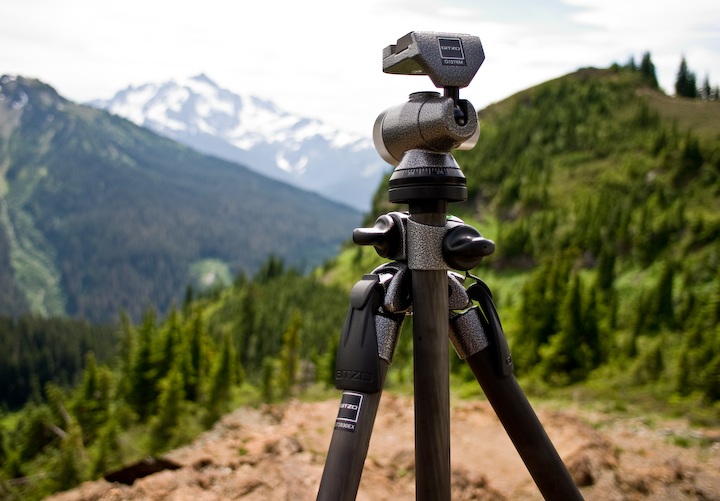
Gitzo Explorer GT2530EX Carbon Fiber Tripod, $600 list price.
Gitzo G1276M Universal Off-Center Ball Head, $250 list price.
The three section Gitzo Explorer GT2530EX tripod legs are constructed of six layers of carbon fiber which weigh in at 4.1 lbs. (Note that this model is not the same as the Gitzo Mountaineer GT2530 which weighs almost a full pound less.) The G1276M off-center ball head with quick release tips the scales at 1.4 lbs making the two together a 5.5 lbs. proposition. If you primarily shoot digital SLR gear and don’t use big glass much, you could save a pound by using a compact ball head instead.
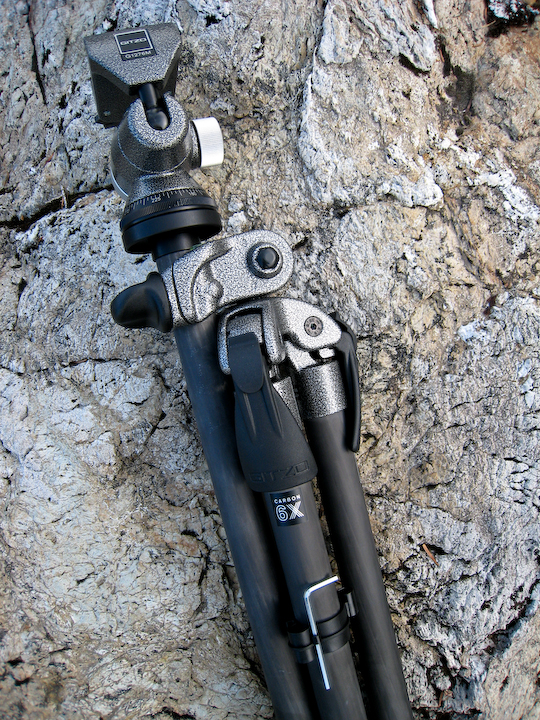
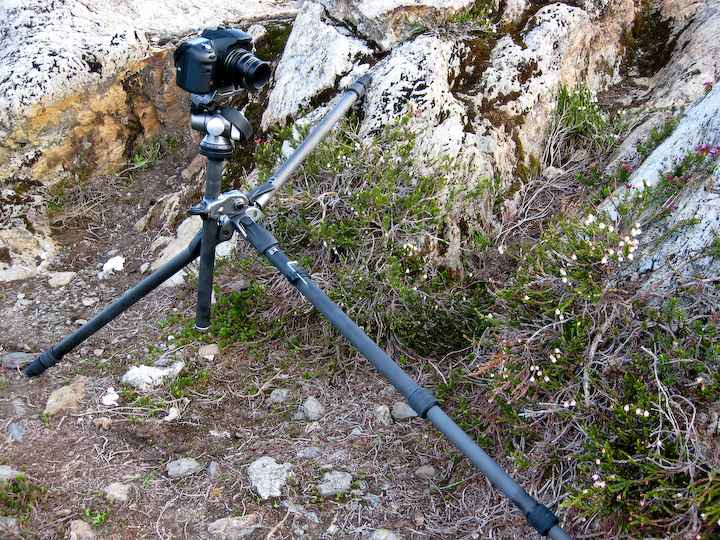
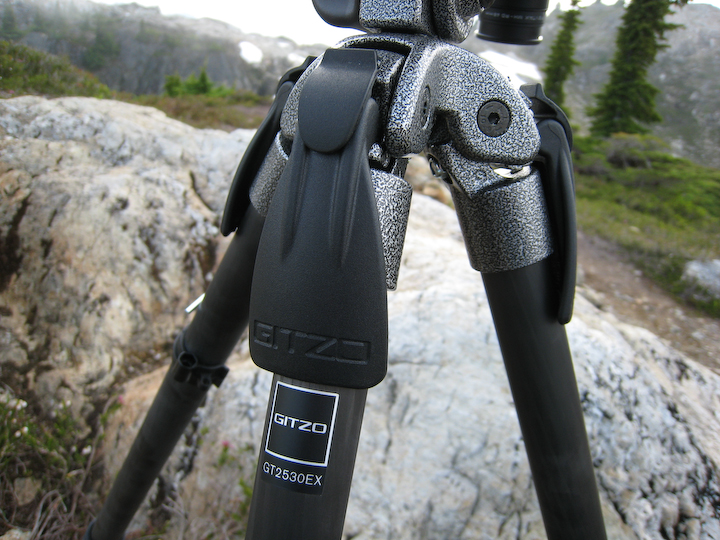
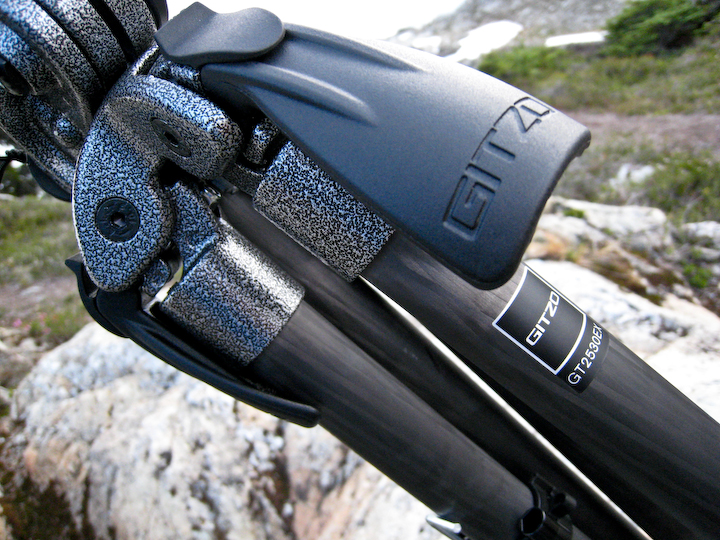
This combination seems to be the ultimate in versatility and is almost as fast to use as the Manfrotto 458B. If you thought a horizontal center column was cool, then the GT2530EX tripod takes you to the next level. Rather than using a traditional center column running in between the legs, the GT2530EX offsets the column and mounts it in a pivoting clamp at the top of the legs. This allows the column to be quickly set at any angle including straight down. I wish I had had this tripod during my last food photography assignment. The ability to quickly adjust your camera position without having to move the whole tripod or adjust the leg heights is of tremendous benefit to anyone doing careful compositions. I’m told Gitzo’s customers in Asia are big fans of this capability.
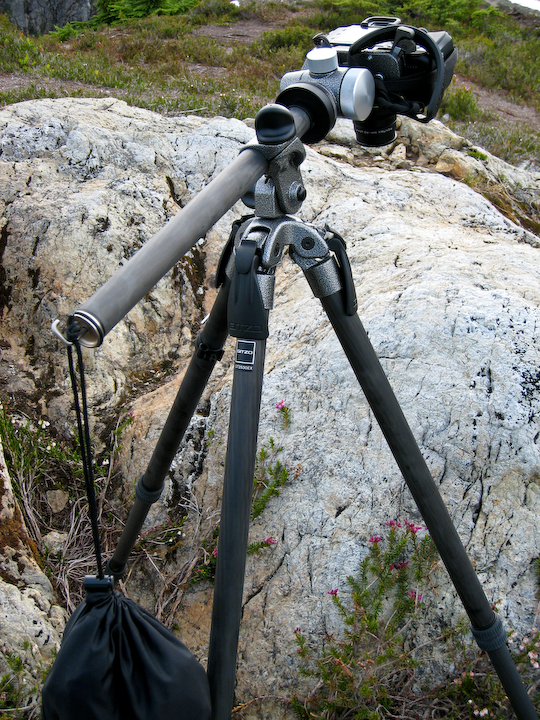
Gitzo uses the same clamp concept for the legs too. Did you ever wish that you could lock the angle of a tripod leg in between the detents? The Gitzo GT2530EX enables you to do just that with flip lock clamps instead of the usual ratchet mechanism (take care when opening or closing these levers as it’s easy to pinch yourself). Because there are no detents for the leg angle, I found that it was easiest for me to set the legs where I wanted them before locking the leg angle clamps down. By working this way, you can easily set the legs up straight and level or at an angle. This feature is extremely useful when working outdoors on uneven terrain or in tight spaces. Indoors, imagine what you can do over and around tables or other objects!
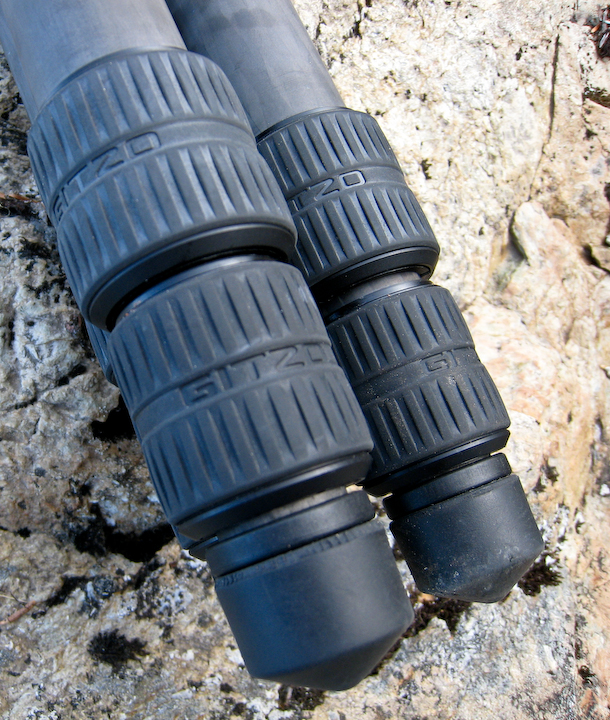
For the leg sections, Gitzo’s twist G-Locks are designed with a very short throw so that tightening or loosening is only about a quarter turn. There is also a slight detent on the releasing turn so you know you’ve released the leg. Being a fan of flip-locks on tripod legs, I did not think I’d find the twist-style locks to my liking, but Gitzo’s design works very well and has turned me into a believer.
Gitzo’s G1276M off-center ball head design is a hybrid between the movements of a pan/tilt head and a regular ball head. The ball head itself is offset from the center of the head and is mounted sideways 90 degrees to vertical. The body of the entire head rotates 360 degrees and locks independently from the ball head. Functionally, this provides a little more flexibility in camera positioning when using the head with the GT2530EX tripod in an unusual configuration. Again, with food photography or any macro work, this head can help make quick refinements without the need to reposition the whole tripod. The G1276M ball head is constructed of magnesium and comes with its own quick release plate. It may look bulky, but it’s relatively light weight and compact with the top plate stored down. Then again, it is not as light as some regular ball heads built for backpacking. My other concern with this head is that the smoothness of the ball head motion is a bit sticky when compared to regular ball heads; this may or may not be an issue for you however.
The Gitzo Explorer GT2530EX carbon fiber tripod and the G1276M head are a compelling combination if the price is not an object. Gitzo promotes the tripod as the perfect tool for “exploring new perspectives” and I have to agree that the total flexibility of positioning makes the combination extremely attractive for those shooters needing such versatility.
In conclusion, I hope this series has been useful for helping you set your own priorities around tripods and tripod features. There certainly are plenty of traditional tripod designs to choose from, but if you’re in the market for a new model, be sure to give these new features a look. You may find using a tripod easier and more fun than you expect!

Great review. I’ve been considering this tripod, so the review comes in quite handy. Just a few questions though. Is the Gitzo G1276M necessary to get full functionality from the tripod. I’d been considering either a RRS BH40 or BH55, but would be open to the Gitzo ballhead if it really works better with this tripod. If so do you know if the G1276M works with RSS L-plates?
Bob:
Thanks for the comment. I’d say the head is not strictly necessary. In fact, I like it well enough but a friend of mine found the motion to be sticky (he expected it to be super silky smooth like his Acratech Ultimate Ball Head). You are able to do some things a wee bit (and I mean just a wee bit) easier with the off-center design than with a traditional ball head.
Personally, I think any decent ball head should work fine. I don’t know for sure but I’d guess the G1276 does not work with RSS’ stuff–it has it’s own plate design.
If you do a lot of fine tuning to your compositions you might give the Gitzo G1276 a try, but also use your regular head too to see if it works the same for you. There are subtle advantages but they’re really particular to one’s style.
Cheers,
LC
Thanks for the review. I like the versatility of this tripod but I was wondering about its ability to use the centre column as a leveller for pano work. I would rather not have to worry about getting the tripod exactly level and do all the levelling with the centre column. Cheers, Allan
Hi Allan,
I haven’t done enough pano work to advise you on the technique you’re asking about. In theory, the center column could function this way with a level on the head itself, but you may be rotating from the center, or you may be pivoting around the lens’ axis.
You certainly can position the center column in a variety of angles and positions so if you’re only rotating around the center column’s central axis, then the head can do all the work, so to speak.
Then again, with the software nowadays, this may or may not be an issue for you depending on how critical your stitching needs to be.
Hope I answered your question.
LC
Thank you for your detailed review of this tripod. It has been difficult finding useful reviews of Gitzo tripods on the internet. Your review is simply the most in-depth I have come across. I am rather new to photography and I only recently purchased my first DSLR, a used D70s from a friend. The only lenses I have is a Nikon 50mm f/1.8 Tamron 28-75mm f/2.8 and a Sigma 10-20mm f4-5.6. I plan on buying a macro lens and a fast f/2.8 telephoto lens.
However, the only thing on my mind right now is getting a quality tripod and head. I have read that many people end up wasting a lot of money and time buying several tripods that are cheap but unsturdy and unreliable. I don’t want to make this mistake. I don’t mind spending 500+ on a quality tripod and another 200+ on a head and be happy with it for the next 10 years.
My question is, do you recommend the Gitzo GT2530 to an amateur photographer? I am still new to photography but I do plan on putting in time and effort to it.
I am looking for a lightweight, versatile tripod and have read your very thorough review of this model. Because weight is particularly important to me, can you tell me how this model compares to the Gitzo Mountaineer GT 2530 (which is lighter in weight) in the area of other features? I have a Aratech V2 ballhead and also wound want to make sure it would work with these tripods.
Thank you.
Gabriel: Sorry I missed your question way back…Hope you found a tripod you’re happy with now.
Freda: I don’t have the 2530 so the things to look for in a comparison are the way the legs lock (detents vs. any position) and of course the horizontal arm (which also locks in any position). The weight of this GT2530EX may be too much for light weight folks, but the trade off is the great flexibility that the no-detent locking legs and horizontal arm provide. It is very useful IMO to have legs that lock wherever you want, rather than having to work around the detents by adjusting leg length. This isn’t a big issue really but some people may care enough to trade some weight for flexibility, particularly those who aren’t schlepping their gear around on their backs.
LC
Oh yeah, forgot to say almost all tripods have standard threaded bolts to mount a head. There are probably some unusual combinations but I wouldn’t worry about a mainstream photo head fitting on a photo tripod.
Straight answers, no hype.. beautiful..
Laurence, could you comment on the new GT 2540 EX model. Specifically sturdiness of the 4 leg section model compared to the 3 leg sections of the 2530, the tubing will be smaller..
Also Gitzo has released an entire line of new off center ball heads. Any thoughts on those.. I am thinking of mating the GT 2540 with the GH3750QR head for some extra height (I am 6foot 4inches) and capacity (aspiring to one day own a 500MM fixed Nikor, wow). That might be crazy because of the extra weight at the end of the lateral arm. Any thoughts?
I am a D300 kind of guy if that matters…
Just out of sheer curiosity, why do you write “Gitzo and Manfrotto’s engineers may work in the same building”? Manfrotto has always been in Italy, Gitzo in France. Do you know of a joint engineering effort anywhere on the planet?
As far as I know, the only thing Gitzo and Manfrotto have in common is their US distributor, Bogen.
Thanks in advance.
Thanks for an excellent review, I am now the proud owner of a Gitzo explorer!
Nice photos to!
I own the Gitzo GT2541EX tripod – it’s got one more leg section than the one you reviewed. (The trade off was it being more compact folded up (easierfor travel) as opposed to the 2530 or 2531 being more sturdy by not having the thinner final leg section.) I use a RRS B-40 head (it’s a medium sized head) which seems fine for it.
It’s a great tripod as you’ve noted and usually works very well and sets up quickly for odd and complex terrain situations. Also great having that easily adjustable horizontal arm for the low shots and overheads.
HOWEVER my beef with the flip lock mechanism is that they do SLIP, unlike Gitzo’s detente leg locks on their other models!! Not good. Especially bad when the legs are splayed out for low shots and macros and the thing starts sinking. Sheeeeshsh… And I’m not using any extraordinary amount of weight on it either – a Canon 50D with a macro lens.
I tried to tighten the Allen screws which the legs pivot on, but they’re already tightened up all the way. If I can’t find a solution I’m going to have to find another solution. If you have an answer for me I’m all ears!
Thanks.
I’m afraid I have to agree with the previous poster, Mark.
I too own a Gitzo Explorer (the aluminium 2220 version). And I absolutely love the flexibility the overall design provides!! (Since I often shoot macros of plants…which can lie flat against the ground, or on a rocky bank, or within a stream-side crevice, etc.) Overall it sets up nicely and is a pleasure to use, except …
…the flip-lock mechanism for the legs too often SLIPS!!
This is especially problematic when the legs are fairly splayed out to access a low height subject. This kinda defeats the whole purpose of getting a Gitzo…which I presumed would give a truly firm and stable platform for my painstakingly composed and focused shots. Far too often, the legs slip right after I’ve labored to get everything right.
And this even happens using my Canon Rebel and 50mm compact macro lens…an SLR load could hardly get lighter!
Again, I love the tripod design…but something seems very wrong here! I’m taking it in for service ASAP. Hope the problem can be corrected.
HOWEVER my beef with the flip lock mechanism is that they do SLIP, unlike Gitzo’s detente leg locks on their other models!! Not good. Especially bad when the legs are splayed out for low shots and macros and the thing starts sinking. Sheeeeshsh… And I’m not using any extraordinary amount of weight on it either – a Canon 50D with a macro lens.
I tried to tighten the Allen screws which the legs pivot on, but they’re already tightened up all the way. If I can’t find a solution I’m going to have to find another solution. If you have an answer for me I’m all ears!
————————————-
…the flip-lock mechanism for the legs too often SLIPS!!
This is especially problematic when the legs are fairly splayed out to access a low height subject. This kinda defeats the whole purpose of getting a Gitzo…which I presumed would give a truly firm and stable platform for my painstakingly composed and focused shots. Far too often, the legs slip right after I’ve labored to get everything right.
————————————-
Her’s how to fix the leg slippage:
You need to adjust the nut on the underside of the leg. Open the leg fully, and you’ll see a nut on the underside. This actually controls the tension of the leg locks. The Allen screws hold the legs on the spider assembly, and act as pivots for the legs. Get a 5/16 nut driver and keep it in your camera bag. You’ll be glad you did.
Laurence, I can’t thank you enough for that sage advice!!!! It immediately fixed my problem and I am now enjoying the heck out of my GT2541EX!!! BEAUTIFUL!
One thing – I’d recommend an 8mm nut driver as opposed to the 5/16″ as Gitzo’s are done with metric parts.
Thanks so very much for this invaluable tip. Truthfully I was ready to dump this great piece of equipment/design and now you’ve brought it back to life for me!
It’d be nice if Gitzo would do up their owner’s manuals in a more helpful/complete way than they’re notorious for.
I just got a 5/16″ nut driver, and when compared with the 8mm, it seemed like a more secure fit.
Nice review thanks for posting it.
I too am considering purchasing the Gitzo Explorer tripod and like Bob (above) I’m considering the Really Right Stuff (RRS) BH-55 or BH-40 ballhead for it.
The only thing I can’t find out about the Gitzo is the diameter of the top plate. I think this will be the ultimate factor in which head I purchase or even whether I get this tripod.
Ideally I want the RRS BH-55 head as it will never need to be upgraded if I change tripods whereas the BH-40 might need to be upgraded.
If the Gitzo toplate is slightly larger than the BH-40 I could encounter problems when putting the ball in it’s horizontal position with the clamp I want. However, the BH-55 base diameter is about 72mm and if the Gitzo’s toplate is fairly small I think the head will look stupid and possibly less stable on this tripod.
So, if you are able could you let me know the toplate diameter, it would be greatly appreciated.
Once again thanks for the review.
One Question…. Have a D700 with a 70~200 Lens… Will this setup work on this tripod ?
@rob, it should work. I’m using 5d mk ii with 70-200 f/2.8 lens. have no complaints at all. i’m using the 4 legs version, the 2451ex
Well, I don’t know what to do… Can someone help?
Is it better to have an OFF CENTER head without the tension control and spirit (level) bubble or is it better for a CENTER head that has these 2 features?