

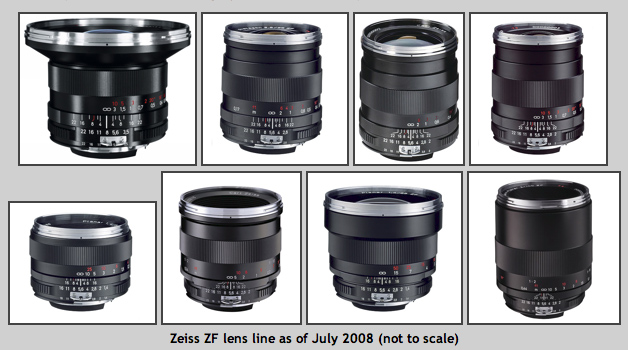
 The Zeiss ZF lens lineup at of August 2008
Introduction
In this era of plastic-barreled mass-produced lenses, the Zeiss ZF lenses stand out in sleekly-elegant fashion, with their beautiful and durable all-metal design. For the past year, I’ve used the entire Zeiss ZF lines extensively on both Canon EOS and Nikon, with outstanding results(see the diglloyd blog beginning June 2008). My Guide, Zeiss ZF Lenses, goes into depth on the lenses. This page captures my thoughts on this superb lens line. If you’d like specifications on weight, size, etc, please see the Zeiss web site; this review won’t go into that stuff. You might also want to see the Zeiss July 2008 Camera Lens News.
The unanswerable question that will invariably be asked is whether the Zeiss ZF lenses are “worth it”—are they actually “better” than an equivalent Nikon or Canon lenses? There is no unequivocal answer to that question unless priorities are specified. Here are just a few of the considerations:
- Wide-open vs stopped-down sharpness and contrast throughout the frame;
- Ability to distinguish subtle tones, particularly in highlight or shadow areas;
- Color rendition, distinguishing fine nuances of color;
- Maximum aperture;
- Bokeh;
- Flare spots and veiling flare;
- Distortion;
- Automatic vs manual operation;
- Compatibility and ergonomics, especially focusing;
- Build quality;
- Cost.
For example, photographers who prize bokeh (rendition of out-of-focus image detail) will be strongly motivated by the 100mm f/2 Makro-Planar, which offers stunning results. By comparison, photographers who need to shoot rapidly will find the lack of autofocus a show-stopper. Still others might be put off by the cost. There is no scoring system that can yield an answer appropriate to everyone.

Photographers who prize consistently high image quality (especially wide open), pleasing bokeh, and first-rate build quality will find the Zeiss ZF line very attractive, so long as fully automatic operation is not a key requirement.
Why buy a manual focus lens today? While autofocus is the cat’s meow for many shooting situations, manual focus with the buttery-smooth focusing helicoid of the ZF line is well suited to numerous photographic opportunities, not to mention situations where the autofocus points just don’t cover the desired area. And with Live View as found on current Nikon and Canon DSLRs, precision manual focus works so much better with a focusing helicoid, as compared with the twitchy autofocus-in-manual-mode AF lenses. As a worst-case example, I literally cannot even remove my finger from the Nikon 50/1.4D focusing barrel without disturbing the focus! Precision work does not tolerate even minor focus errors with high resolution digital cameras—there is no “post” for focus errors.
Which cameras?
The “ZF” designation includes the “F” for Nikon’s “F” mount used by all current and past Nikon SLRs, digital or film. With an adapter, Canon users can use them in manual-stop-down mode (focus, stop the lens down, shoot). That is not a fast-working approach, but works very well indeed for any kind of tripod work, and is a non-issue when shooting wide open. Zeiss also offers a “ZK” line for Pentax or Samsung, and a “ZS” M42 screw mount version. The optics are the same in all cases. See the Zeiss web site for details.
Zeiss ZF Build quality
Visually, the lenses are very attractive and the elegant appearance speaks volumes about the quality. Actual build quality is extremely high in the ZF lineup. Comparing Zeiss ZF lens build quality to similar lenses in the Nikon and Canon lineup is no contest—one can see at a glance the difference in materials and workmanship, and this is confirmed in the handling. It goes beyond just looks and durability; it extends into the silky-smooth focusing helicoid, something just not to be found in today’s Nikon or Canon lenses, and rarely even in older lenses. However, the ZF lens line is not sealed for water and dust as are some of the newer Canon and Nikon “pro” lenses.
The lens bodies appear to be entirely metal, finished in a semi-matte black. A slightly less reflective surface might have been nice, but that’s a quibble. All markings are engraved, a welcome reprieve from the cheap printed markings found on even high-end Nikon and Canon offerings. Lens hoods are metal also, and all are reversible for easy storage. The downside to metal is that it can bend/dent, and it transfers heat from fingers in cold weather.
Zeiss ZF Color rendition, flare control
The ZF line offers a color balance which is generally warmer (more yellow and a touch of magenta) than most Canon and Nikon and Leica lenses. The ZF line is warmer than even the Leica 90/2 APO-Summicron-R and 180/2.8 APO-Elmarit-R and the Voigtlander 180/2.8 APO. However, it’s more complicated than that—after working with the ZF lens line for over a year, there can be no doubt whatsoever that the color of the ZF lens line is the most pleasing ever encountered by this reviewer. The ZF lenses consistently produce images which are gorgeous. Adjusting color temperature in RAW-file processing for the other brands (even Leica) does not produce the same pleasing result as the ZF lenses; it’s about an entire tonal rendition, not a simple white balance issue. Color is quite simply the most natural and pleasing this author has ever seen. However, the new “nano crystal” coatings offered by Nikon do bridge the gap somewhat.


100/2 Makro-Planar (left), 25/2.8 Distagon (right).
Color rendition is simply gorgeous, and amazingly consistent across the ZF line.
Image rendition and bokeh
Bokeh, or the way a lens “draws” out-of-focus areas, is a highly-subjective area in which there is some disagreement. There are lenses with truly ugly bokeh, but in most cases, it’s like arguing whether chocolate ice cream is better than vanilla! The Zeiss ZF 100/2 Makro-Planar offers perhaps the most pleasing bokeh available today (see below).
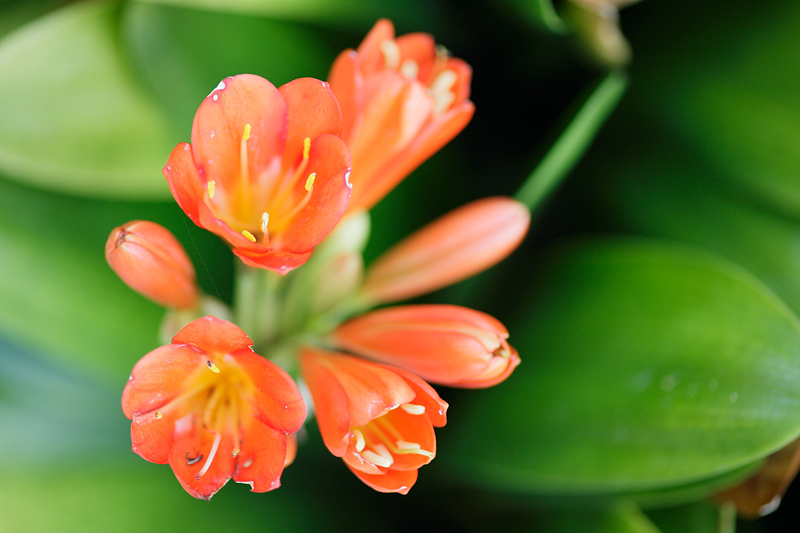
Bokeh is nothing short of stunning with the ARRI optics design of the ZF 100/2 Makro-Planar
Too many photographers seem to think that “good bokeh” means that flat “erased” look seen in many Canon and Nikon designs. The Zeiss designs are different. Better? That’s personal preference, but this author has come to favor the Zeiss rendition over the (numerous) Canon and Nikon lenses at his disposal.
(continued…)

pic4c.com – photos by Sony Alpha and Zeiss lens, Hong Kong, Ho Chi Minh (Saigon)
Fantastic image samples…Quite impressive workmanship,performance. I must start saving…
Stunning examples- even at these small sizes, I can see the exquisite contrast and multi-layered bokeh. Also, regarding flare-resistance, I have never seen anything like it. I wonder about these, yet also whether Sony has the same quality in an auto-focus and image-stablised line, offering ‘the best of the old with the best of the new’. Well, I can barely afford one of these lenses now, let alone a second system. Only time will tell, ‘sigh’.
Carl Zeiss-the Best from best.
Seems the line up comments are consistent with my experience of Zeiss glass used on Contax cameras (both SLR and G series). Even the small nuances, like 85/1.4 not suitable for close up.Hopefully one day when my old Contax equipment dies Zeiss lenses will still be available on modern SLRs!
Thank you for this wonderful review of the Zeiss lenses.
I am a Nikon user, looking for a perfect Fine Art combination.
As an industrial photographer for many years, I have had a Leica M-6 system, and a few Hasselblads, and thrilled with the quality. I have always liked my Nikon, but it was not in the same league as the other two.
Because of the cost of the New Leica M-9 and lenses, I feel Hasselblad should concentrate on the fine artist, instead of trying to compete with 35mm DSLR which I think they are failing.
I am looking for a camera system that might be affordable (some what) with superb quality. I am leaning towards a Nikon D-700x, and 3 Zeiss lenses. (18, 35, & 100). I mostly shoot on a tripod, and check my focus and composition several times before firing the camera.
For these reasons, I prefer manual focus lenses, but heard that Zeiss is now built in Japan and not the same quality as my German Hasselblad lenses.
That is why I feel your review on these products is so helpful to me,
Thanks,
Eric, (the Photomaker)
do ZEISS ZK-mount lenses come with electronic interfaces , thereby allowing it to actuate the focus confirmation mechanism of Pentax cameras ?
thank you !
“The f/2 maximum aperture is unique among macro lenses”
Not quite, the Olympus Zuiko 90mm f2 did it years ago and still does. You are correct only in that it isn’t in production, but as such a wonderful (and my favourite) lens it shouldn’t be forgotten. A new classic doesn’t negate an older one.
There was/is a Zuiko 50 mm f2 as well, of course.
It pays to remember that there are more camera brands than Canon and Nikon.
Don’t forget all Zeiss lenses had the past in Dresden, where the CZJ Lenses was made with superb quality and
somtimes not so goodmaterial as it was not available under comunist regiem but the glasses are today still wonderful.
and remenber CZJ Lenses was the Mother of all Nikon and Canon “replicas”.
For my Canon I use Pentacon PB lenses 1.8/50. 1.8/80 and 2.8/135, all are quit good performers.
for the Nikon F100 I use Pentacon 2.8/120 and 2.8/180mm both are great Lenses.
i just started working with the ze 100/2 Makro and the 50/1,4 Planar….
it feels great!! and the pictures look great … u got to have at least the EG-S Screen…but then… everything is working great!
I have never used any carl zeiss lens. But from what i have seen, seems to be a good lens.
Amazing! Just when I thought I had completed a satisfactory collection of older manual focus Zeiss Jena and Nikon lenses along comes Zeiss ZF for Nikon and your stunning examples. Back to square one!
I am still confused about why Zeiss do not manufacture their lenses in Germany? Why Japan where mass production and a different manufacturing philospohy prevails than in Germany which IS the world’s best.
I am looking for a portrait 85 mm lens, possibly with larger aperture. I understand that Zeiss has a Planar T 85/1.4 but I am confused why it is not manufactured and packaged in Germany??? If there are some of these made in Germany also, please inform me via email and I will go out of the way to purchase it.
Thank you,
Usman.
For cost reasons. If it was made in Germany, they will probably cost $5000 instead of $2000. While you may go out of your way to buy regardless, most people probably won’t. Hence the strategy to make it in Japan.